1. What Are Explosive Precursor Chemicals?
“Explosive precursor chemicals” are a specifically regulated category of hazardous chemicals. According to China’s Catalogue of Explosive Precursor Chemicals (2017 Edition), they are divided into nine categories, including acids, nitrates, chlorates, perchlorates, dichromates, peroxides and superoxides, flammable reducing agents, nitro compounds, and others.
Common examples found in laboratories include nitric acid, potassium chlorate, potassium perchlorate, potassium dichromate, and high-concentration hydrogen peroxide.
Their management involves not only chemical safety risks such as fire, spills, and corrosion, but also security risks such as theft, unauthorized access, and loss.
The two-person, two-lock system primarily addresses the latter.
2. What Does the Two-Person, Two-Lock System Secure?
Simply put:
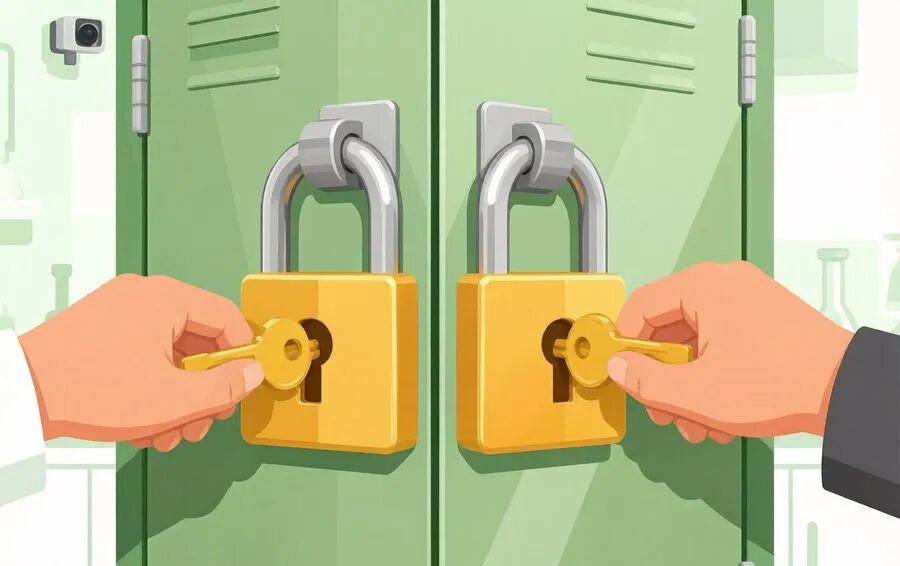
The two-person, two-lock system is designed to prevent any single individual from accessing the chemicals alone.
According to the Laboratory Safety Inspection Checklist for Higher Education Institutions, explosive precursor chemicals should be stored in compliance with quantity limits and managed under a two-person, two-lock system.
Typically:
The cabinet is equipped with two independent locks;
The two keys are held separately by different authorized personnel;
Two authorized personnel must be present to open the cabinet;
Chemical receipt, use, and return must be recorded.
This creates a system of dual-person control, mutual oversight, and full traceability, reducing the risk of unauthorized access or loss of control.
3. Storage Facilities and Locks Also Matter
The two-person, two-lock system does not simply mean adding two padlocks to an ordinary laboratory cabinet.
According to GA 1511-2018, Security Requirements for Storage Sites of Explosive Precursor Chemicals, and other applicable requirements, storage facilities should incorporate appropriate anti-theft protection. Dedicated storage cabinets should provide anti-theft features, and the locks should meet applicable requirements for mechanical security locks.
Therefore:
Ordinary glass-door laboratory cabinet + standard padlock ≠ compliant storage for explosive precursor chemicals.
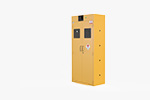
When selecting a dedicated cabinet, focus on its anti-theft construction, lock configuration, and two-person, two-lock function.
4. Storage Quantity and Location Must Also Comply
The storage method for explosive precursor chemicals depends on the storage quantity and application scenario.
According to the Administrative Measures for the Public Security Control of Explosive Precursor Chemicals (Ministry of Public Security Order No. 154), explosive precursor chemicals that constitute a major hazard source should be stored separately in dedicated warehouses and managed under a two-person receiving/dispatch and two-person custody system.
For educational, research, medical, and testing institutions, storage rooms or cabinets may be used in accordance with applicable requirements. Specific requirements depend on the storage quantity and actual application.
Relevant regulations also set limits on the quantity that may be stored in an individual storage room or cabinet.
Therefore, small-quantity laboratory storage should not be treated in the same way as large-scale chemical warehousing.
5. Three More Key Management Measures
(1) Control the Storage Quantity
Under the relevant regulations, the quantity of explosive precursor chemicals stored in an individual storage room or cabinet at educational, research, medical, and testing institutions must remain within the applicable limits.
In practice, inventory should be controlled according to actual laboratory needs, avoiding unnecessary long-term storage.
(2) Cover Key Areas with Video Surveillance
According to GA 1511-2018, video surveillance at storage-area entrances and exits should clearly identify personnel entering and leaving. Surveillance of storage areas should capture chemical access and personnel activities.
Video footage should be retained in accordance with applicable requirements and for no less than 30 days.
(3) Maintain Complete Inventory Records
Management should cover not only storage, but also chemical movement and usage.
Receiving, dispensing, inspection, and record-keeping procedures should be established, with regular inventory checks to ensure traceability of:
Who took it, how much was taken, where it was used, and how much remains.
Any missing, stolen, or forcibly taken explosive precursor chemicals should be reported to the relevant public security authorities as required.
6. What Is the Difference Between a Dedicated Explosive Precursor Cabinet and an Ordinary Chemical Cabinet?
In simple terms:
An ordinary chemical storage cabinet focuses primarily on chemical safety, while a dedicated explosive precursor cabinet must also address security and access control.
When selecting a storage cabinet, focus on:
① Anti-theft construction
The cabinet should incorporate appropriate anti-tampering and anti-theft features, with locks meeting applicable standards and requirements.
② Two-person, two-lock control
Two independent locks should be controlled by different authorized personnel, preventing a single person from opening the cabinet independently.
③ Chemical safety
Chemical segregation, incompatible chemical separation, storage quantity, spill prevention, fire protection, structural stability, and appropriate ventilation should also be considered.
7. The Key Takeaway
Ordinary chemical storage focuses primarily on chemical risks, while explosive precursor chemical storage must address both chemical safety and security risks.
The two-person, two-lock system is more than simply adding a second lock. It combines dual-person control, access management, video surveillance, and inventory traceability to reduce the risks associated with unauthorized access and loss of control.
Effective management means ensuring that every access is authorized, every chemical is accounted for, and every abnormal event can be traced.